Is Sauerkraut Good for Gut Health? Yes — If It's Raw
Yes — is sauerkraut good for gut health? Raw sauerkraut is one of the best-value probiotic foods: live cultures, fibre, and compounds that protect your gut lining, for about 20 calories a serving. The catch is the jar — canned, shelf-stable sauerkraut has no live cultures at all.

Key Takeaways
- Is sauerkraut good for gut health? Yes — if it is raw and refrigerated. Shelf-stable canned sauerkraut has no live cultures.
- Raw sauerkraut delivers **live Lactobacillus cultures, fibre (~1 g per 2 tbsp), and gut-lining compounds** from fermentation.
- A UC Davis lab study found sauerkraut protected intestinal cells — raw cabbage and brine alone did not.
- An IBS trial found daily sauerkraut improved symptoms in 6 weeks — with pasteurised sauerkraut too.
- Watch the sodium: about 900 mg per cup. Start with 2 tablespoons (~110 mg) a day.
Table of Contents
How Does Sauerkraut Help Your Gut?
Sauerkraut helps your gut in three ways: live bacteria, fibre, and fermentation compounds. The bacteria add to your microbiome’s diversity. The fibre feeds the bacteria already living there. And the fermentation process creates lactic acid, amino acids and plant chemicals that support the gut lining. All three work together — which is why sauerkraut does more than raw cabbage alone.
Live bacteria. Raw sauerkraut is fermented by Lactobacillus bacteria, which produce lactic acid and give sauerkraut its tang. These are the same family of bacteria found in yogurt and kefir. They pass through your gut, adding diversity while they are there.
Fibre. Sauerkraut has about 1 g of fibre per 2-tablespoon serving. That is not a lot on its own, but it is prebiotic fibre — the kind your gut bacteria feed on. Fibre and live bacteria together are the reason is sauerkraut good for gut health gets a yes: the fibre feeds the bacteria, including the ones the sauerkraut delivers.
Fermentation compounds. Fermentation does more than preserve cabbage — it transforms it. The process creates lactic acid, amino acids and plant chemicals that were not in the raw cabbage. UC Davis researchers found that these compounds, not just the live bacteria, help protect the cells lining your gut. That is a key part of is sauerkraut good for gut health: the benefit is not only about probiotics.
Sauerkraut is one of the best foods for gut health — and one of the cheapest. A jar of raw sauerkraut costs less than a tub of probiotic yogurt and lasts for weeks in the fridge. That value is part of why is sauerkraut good for gut health is worth asking.
What Does the Research Say?
The research on sauerkraut is stronger than for kombucha but thinner than for yogurt. Three studies matter most for is sauerkraut good for gut health: a UC Davis lab study, an IBS trial, and the Stanford fermented-food trial. Here is what each one actually found.
UC Davis lab study (Marco & Wei). UC Davis researchers tested sauerkraut, raw cabbage and sauerkraut brine on intestinal cells in the lab. Sauerkraut protected the cells’ integrity — they held together better under stress. Raw cabbage did not. Brine alone did not. Grocery-store sauerkraut worked just as well as lab-made. The honest limit: this was a lab study on cells, not a human trial. Read the university’s summary at UC Davis.
IBS pilot trial. In a randomised, double-blind pilot trial, people with IBS who ate sauerkraut daily for 6 weeks saw symptoms improve and gut bacteria shift. The surprise: pasteurised sauerkraut helped too — not just raw. That suggests the benefit is not only about live bacteria; fibre and fermentation compounds matter as well.
Stanford 2021 fermented-food trial. In a 17-week trial with 36 adults, eating about 6 servings of fermented food a day (including sauerkraut) increased gut diversity and lowered 19 inflammatory proteins. Sauerkraut was one food among several, so this is not proof about sauerkraut alone — but it supports the case for fermented foods as a group.
So is sauerkraut good for gut health by the standard of hard evidence? The lab evidence is strong, the IBS trial is promising, and the Stanford trial supports fermented foods generally. Human trials of sauerkraut alone are still needed — but the direction is consistent.
Raw vs Pasteurised Sauerkraut — Which One Helps Your Gut?
Raw sauerkraut helps your gut more — but pasteurised sauerkraut still helps. That is the short answer to is sauerkraut good for gut health when the jar is canned: partly, yes. The difference is the live bacteria: raw has them, pasteurised does not. Here is how to tell them apart.
| Raw sauerkraut | Pasteurised (canned/jarred) | |
|---|---|---|
| Where it lives | Refrigerated section | Shelf-stable aisle |
| Live cultures | Yes | No (heat killed them) |
| Fibre | Yes (~1 g per 2 tbsp) | Yes (same) |
| Fermentation compounds | Yes | Mostly yes |
| Shelf life | Weeks (fridge) | Months/years |
| Price | Higher | Lower |
How to spot raw sauerkraut: it is in the refrigerated section, the label says “raw”, “unpasteurised” or “naturally fermented”, and the ingredients are just cabbage, salt and water (sometimes caraway seeds). If the jar is on a shelf at room temperature, it has been pasteurised — no matter what the label says about fermentation.
Why pasteurised still helped in the IBS trial: the fibre and fermentation compounds survive pasteurisation, even though the bacteria do not. So if you can only find canned sauerkraut, it is still worth eating — you get the fibre and the compounds, just not the live cultures. Raw is better, but canned is not useless.

How Much Sauerkraut Should You Eat?
Start with 2 tablespoons a day and build up to ¼–½ cup over one to two weeks. Two tablespoons is a small forkful — enough to deliver live cultures and fibre without overwhelming your gut or your sodium budget. Is sauerkraut good for gut health at just 2 tablespoons? Yes — even a small amount adds live bacteria and fibre.
Start-slow plan:
- Days 1–3: 2 tablespoons (about 30 g) a day, with a meal.
- Days 4–7: ¼ cup (about 60 g) a day.
- Week 2 onward: ¼–½ cup a day, or as much as you enjoy.
| Serving | Sodium | Fibre | Calories |
|---|---|---|---|
| 2 tbsp (30 g) | ~110 mg | ~1 g | ~6 kcal |
| ¼ cup (60 g) | ~225 mg | ~2 g | ~12 kcal |
| ½ cup (120 g) | ~450 mg | ~4 g | ~25 kcal |
| 1 cup (240 g) | ~900 mg | ~8 g | ~50 kcal |
Eat it with food, not on an empty stomach — the salt and acid are gentler that way, and the food helps the bacteria survive stomach acid. If you feel bloated at first, drop back to 1 tablespoon and build up more slowly. A little gas in the first week is normal as your gut adjusts.
Is Sauerkraut Too Salty?
Sauerkraut is salty — about 900 mg of sodium per cup. That is the main catch behind is sauerkraut good for gut health: a lot in a whole cup, but a normal serving is much smaller. Two tablespoons has about 110 mg, under 5% of the 2,300 mg daily limit. Sodium only becomes a problem in large amounts.
The rinse trick. If sodium is a concern, rinse the sauerkraut in a colander under cold water before eating it. Rinsing reduces the sodium — though it also washes away some of the brine and its compounds. It does not wash away the live bacteria inside the cabbage, so raw sauerkraut still works after a rinse.
Who should limit sauerkraut: if you have high blood pressure, heart disease or kidney disease, talk to your doctor about how much salty food fits your diet. The 2-tablespoon serving is small enough for most people, but your doctor knows your limits. For low-sodium meal ideas, see our low-sodium vegetable soup.
The gastric cancer note. A Japanese cohort study found that high intake of salty fermented foods was associated with increased gastric cancer risk. That is an association, not proof of causation — and the amounts in that study were far higher than a daily forkful of sauerkraut. It is a reason to eat sauerkraut in moderation, not a reason to avoid it.
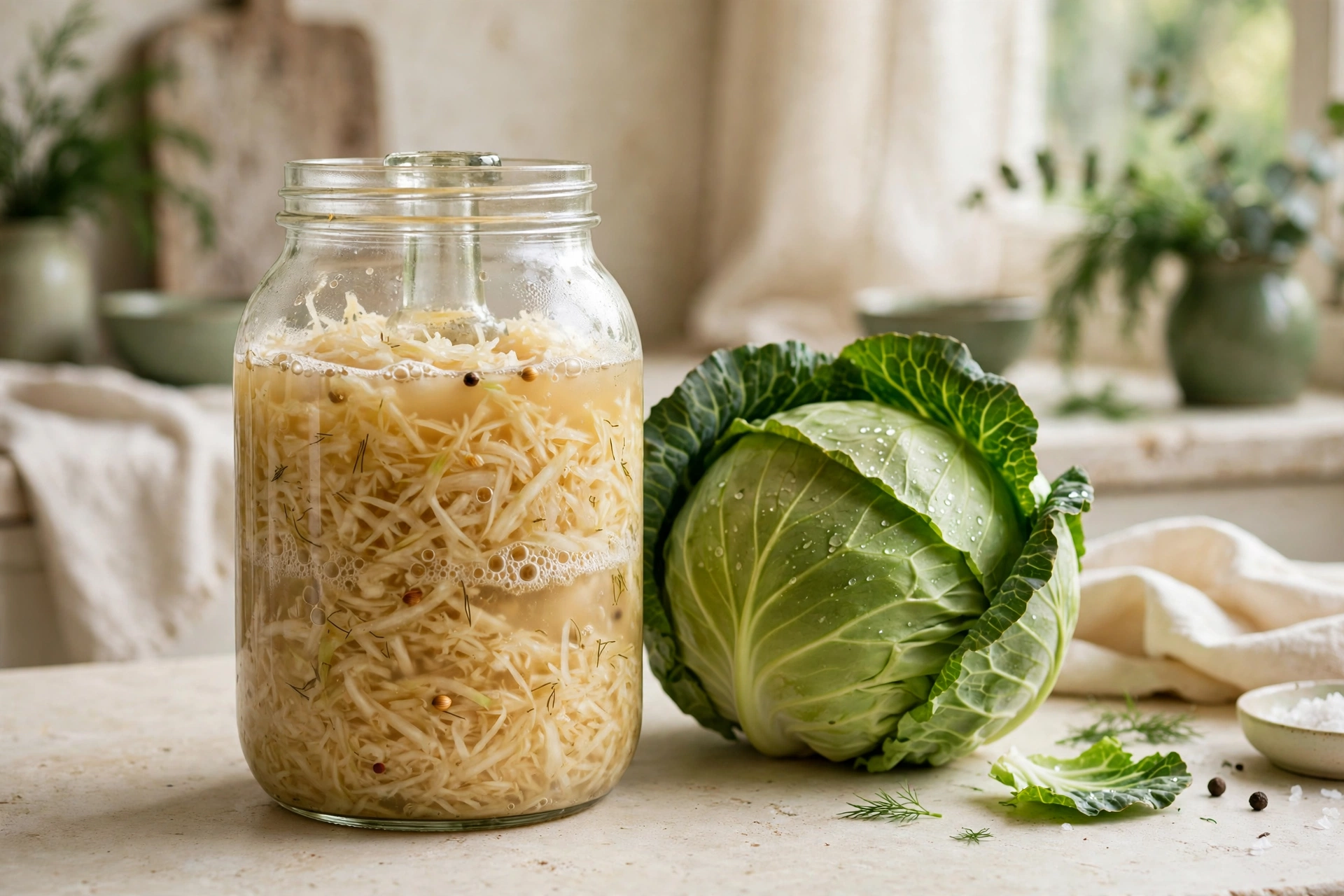
Sauerkraut vs Kimchi for Gut Health
Sauerkraut and kimchi are cousins — both are fermented cabbage, both carry Lactobacillus bacteria. The differences are the base, the spice, and the sodium. Neither is clearly better, so is sauerkraut good for gut health or is kimchi? The best choice is the one you will eat regularly.
| Sauerkraut | Kimchi | |
|---|---|---|
| Base | Green cabbage, salt, water | Napa cabbage, radish, garlic, ginger, chilli |
| Spice | None (mild, tangy) | Spicy (gochugaru chilli flakes) |
| Live cultures | Yes (raw) | Yes (raw) |
| Sodium per cup | ~900 mg | ~700–900 mg |
| Extra compounds | Lactic acid, amino acids | Allicin (garlic), gingerols (ginger) |
| Heat sensitivity | Cultures die if heated | Cultures die if heated |
Kimchi’s extra ingredients — garlic, ginger and chilli — add their own gut-relevant compounds, but they also make kimchi spicier and harder on sensitive stomachs. Sauerkraut is milder and simpler. If you want the comparison in full, see our guide to kimchi for gut health .
How to Eat Sauerkraut for the Most Benefit
Eat it cold, or add it after cooking — heat kills the live cultures. If you cook sauerkraut in a soup or a stew, you keep the fibre and the flavour, but the bacteria are gone. For the full answer to is sauerkraut good for gut health, eat it raw or barely warmed.
Serving ideas:
- On a sandwich or hot dog — the classic. A forkful on top adds crunch and tang.
- Beside grilled meat or fish — sauerkraut cuts through rich food. Try it with grilled chicken and potatoes.
- On a salad — a spoonful over greens adds flavour and fibre without dressing.
- In a grain bowl — sauerkraut, rice, beans and avocado is a complete gut-friendly meal.
- Straight from the jar — a forkful with lunch is the simplest habit of all.
Do not eat sauerkraut from a can that has sat open in the fridge for weeks — transfer it to a clean glass jar and keep it refrigerated. Raw sauerkraut lasts for weeks and gets tangier over time.

Frequently Asked Questions
Questions readers ask most — starting with is sauerkraut good for gut health.
Does sauerkraut have probiotics?
Raw sauerkraut has live probiotic bacteria — mostly Lactobacillus species — because it is fermented, not cooked. Pasteurised (canned) sauerkraut does not: the heat kills the bacteria. Check the label for “raw” or “unpasteurised” and buy from the refrigerated section. The fibre and fermentation compounds survive in both kinds.
How much sauerkraut should I eat a day?
Start with 2 tablespoons a day and build up to ¼–½ cup over one to two weeks. Two tablespoons has about 110 mg of sodium and 1 g of fibre. Eat it with food, not on an empty stomach. If you feel bloated at first, drop back to 1 tablespoon and build up more slowly.
Is store-bought sauerkraut good for gut health?
It depends on which kind. Raw, refrigerated store-bought sauerkraut is good for gut health — the UC Davis study found grocery-store sauerkraut worked just as well as lab-made. That is the practical answer to is sauerkraut good for gut health from a store: buy from the fridge. Canned sauerkraut has no live cultures, though it still offers fibre and fermentation compounds.
Can sauerkraut cause bloating?
Yes, at first — especially if you are new to fermented foods. The live bacteria shift your gut microbiome, and the adjustment can mean gas and bloating for a few days. Start with 1–2 tablespoons and build up slowly. If bloating lasts more than two weeks, talk to your doctor — you may have SIBO or histamine intolerance.
Is sauerkraut good for IBS?
The evidence is promising for is sauerkraut good for gut health and IBS. In a randomised, double-blind pilot trial, people with IBS who ate sauerkraut daily for 6 weeks saw their symptoms improve. Pasteurised sauerkraut helped too — suggesting the fibre and fermentation compounds matter, not just the live bacteria. Start small and track your symptoms.
Should I rinse sauerkraut before eating it?
If sodium is a concern, yes — rinsing under cold water reduces the sodium. It also washes away some of the brine and its compounds, but the live bacteria inside the cabbage survive. If sodium is not a concern for you, eat it straight from the jar for the full benefit.
Conclusion
Is sauerkraut good for gut health? Yes — raw sauerkraut is one of the best-value probiotic foods you can eat: live cultures, fibre, and gut-lining compounds, for about 20 calories a serving. Buy it raw from the fridge, start with 2 tablespoons a day, and watch the sodium.
This article is for general information only and is not medical advice. Please talk to your doctor or a registered dietitian, especially if you have diabetes, heart disease or take medicine.