Low Sodium Ketchup Recipe (2 mg Sodium)

This low sodium ketchup recipe has just 2 mg of sodium per tablespoon — vs about 160 mg in Heinz. Tomato paste, vinegar, honey, and spices, simmered for 15 minutes. No salt, no high-fructose corn syrup — and it tastes like real ketchup.
By Sarah | Last updated: November 17, 2026
Key Takeaways
- 2 mg sodium per tablespoon. Heinz has about 160 mg.
- No salt at all. Tomato paste and spices carry the flavor.
- 20 minutes. One saucepan, six spices.
- Makes about 1 cup. A week of fries and burgers.
- Keeps 2 weeks in the fridge. Vinegar does the preserving.
In This Post
- Why Bottled Ketchup Isn’t Low Sodium
- The Sodium Math
- The Serving-Size Trap
- Ingredients
- How to Make It
- The Spice Blend
- The Honest Sugar Note
- Storage
- What to Put It On
- Nutrition per Serving
- FAQs
Why Bottled Ketchup Isn’t Low in Sodium
Ketchup is the most-used condiment in most kitchens, and one of the saltiest per spoonful. Heinz has about 160 mg of sodium per tablespoon; Hunt’s about 180 mg. A generous squeeze on a burger is easily 2–3 tablespoons — 320–540 mg before the burger itself.
The salt is not there by accident. Ketchup is shelf-stable, and salt is part of what keeps it safe at room temperature for months. It also sharpens the tomato flavor. That is why even “healthier” bottled ketchups are salty — Heinz No Salt Added is the exception at 5 mg per tablespoon, and it costs more.
This low sodium ketchup recipe takes the fresh path: made in 20 minutes from tomato paste, vinegar, and spices, kept in the fridge for 2 weeks. It needs no salt to stay safe, because it never sits on a shelf. Its sweet, tangy flavor comes from honey, vinegar, and the spice blend below.
The Sodium Math: How This Ketchup Stays at 2 mg
Here is every milligram of sodium in the batch, from USDA values and label data:
| Ingredient | Amount | Sodium |
|---|---|---|
| No-salt-added tomato paste | 6 oz (170 g) | 27 mg |
| Brown sugar | 2 tbsp | 8 mg |
| Honey | 2 tbsp | 2 mg |
| Garlic powder | 1 tsp | 2 mg |
| Onion powder | 1 tsp | 1 mg |
| Spices (all combined) | — | ~1 mg |
| Batch total | 16 servings | 40 mg |
| Per serving (1 tbsp) | 2 mg |
Rows are rounded to the nearest milligram; the exact batch total is 40 mg.
The tomato paste is the biggest number — 27 mg; tomatoes contain sodium naturally. The key word is “no-salt-added”: regular tomato paste has about 160 mg of sodium per 6 ounces, which would quadruple the batch total. Check the label — it should say “no salt added” and list under 20 mg per serving.
Two tablespoons of this low sodium ketchup recipe: 4 mg. Two tablespoons of Heinz: about 320 mg. That is 80 times more sodium in the bottled ketchup — for a flavor you can match in 20 minutes at home.
The Serving-Size Trap: 1 Tablespoon vs 2
Ketchup labels use a 1-tablespoon serving size. Almost nobody eats 1 tablespoon of ketchup. A normal squeeze on fries is 2–3 tablespoons, and a burger can take 2 on its own. The number on the label is not the number you actually eat.
| Ketchup | 1 tbsp | 2 tbsp | 3 tbsp |
|---|---|---|---|
| This recipe | 2 mg | 4 mg | 6 mg |
| Heinz | ~160 mg | ~320 mg | ~480 mg |
| Hunt’s | ~180 mg | ~360 mg | ~540 mg |
At 2 mg per tablespoon, this low sodium ketchup recipe makes the serving-size trap irrelevant. Even a heavy-handed 3-tablespoon serving is just 6 mg of sodium — less than a single teaspoon of bottled ketchup. That is the real value of a homemade condiment: use as much as you like without doing the math.
The trap works the other way too. Heinz No Salt Added, at 5 mg per tablespoon, is a good bottled option — but at 3 tablespoons it is 15 mg, more than twice this recipe’s 6 mg. And it costs more than tomato paste.
Ingredients

Ingredients
Method
- Combine. Put the tomato paste, vinegar, water, honey, brown sugar, and spices in a small saucepan. Whisk until smooth.
- Bring to a simmer. Turn the heat to medium and bring the ketchup to a gentle simmer, stirring often.
- Simmer 15 minutes. Turn the heat to low. Simmer, stirring often, until it coats the back of a spoon. It will splatter — use a splatter screen or a lid left ajar.
- Taste and adjust: more vinegar for tang, more honey for sweetness, more black pepper for warmth. The flavor deepens as it cools, so season lightly.
- Cool and store. Cool to room temperature, then pour into a clean jar or squeeze bottle. It thickens as it cools.
Notes
This low sodium ketchup recipe uses no-salt-added tomato paste, vinegar, honey, and a small spice blend.

- No-salt-added tomato paste (6 oz / 170 g): One small can; check the label — under 20 mg sodium per serving.
- White vinegar (¼ cup, 60 g): The tang. Distilled white vinegar gives the cleanest flavor.
- Water (½ cup, 120 g): Thins the paste to ketchup consistency.
- Honey (2 tablespoons, 42 g): The sweetness. It also gives the ketchup a smooth, glossy texture.
- Brown sugar (2 tablespoons, 27 g): Adds deeper sweetness than honey alone.
- Garlic powder (1 teaspoon).
- Onion powder (1 teaspoon).
- Black pepper (¼ teaspoon).
- Ground mustard (¼ teaspoon): Adds a gentle background warmth.
- Cinnamon (a pinch): The secret ingredient — see the Spice Blend section.
- Cloves (a pinch): Ground, not whole. A tiny amount goes a long way.
- Salt: None. Not a pinch.
How to Make Low Sodium Ketchup
This low sodium ketchup recipe takes 20 minutes: combine, simmer 15 minutes, and cool. One saucepan, no blending, no straining.

- Combine. Put the tomato paste, vinegar, water, honey, brown sugar, and spices in a small saucepan. Whisk until smooth.
- Bring to a simmer. Turn the heat to medium and bring the ketchup to a gentle simmer, stirring often.
- Simmer 15 minutes. Turn the heat to low. Simmer, stirring often, until it coats the back of a spoon. It will splatter — use a splatter screen or a lid left ajar.
- Taste and adjust: more vinegar for tang, more honey for sweetness, more black pepper for warmth. The flavor deepens as it cools, so season lightly.
- Cool and store. Cool to room temperature, then pour into a clean jar or squeeze bottle. It thickens as it cools.
The ketchup looks thin when hot. Do not overcook it trying to thicken it — it sets up as it cools, and 15 minutes is enough. If it is still too thin after cooling, simmer 5 more minutes next time. If it is too thick, stir in a tablespoon of water.

The Spice Blend: What Makes It Taste Like Ketchup
Tomato paste, vinegar, and sugar on their own make a sweet tomato sauce — not ketchup. The spice blend is what turns it into ketchup, and two spices surprise people.
Cinnamon and cloves. A pinch of each. These are the warm, background spices in classic ketchup — the flavors you notice when they are missing but cannot name when they are there. Use a pinch, not a teaspoon: too much cinnamon tastes like dessert, and too much clove tastes like medicine.
Garlic and onion powder. One teaspoon each. They add the savory base salt would normally provide. Fresh garlic and onion do not work as well — they add water and change the texture.
Ground mustard and black pepper. A quarter teaspoon each. They add warmth and a faint sharpness. For a spicier ketchup, increase the black pepper to ½ teaspoon.
The blend in this low sodium ketchup recipe is deliberately simple — six spices, all pantry staples. Some recipes add allspice, celery seed, or cayenne, but they are not needed. Cinnamon and cloves do the heavy lifting.
The Honest Sugar Note
This low sodium ketchup recipe has 5 grams of sugar per tablespoon — about the same as Heinz, which has about 4 grams. Ketchup is a sweet condiment, and this recipe does not change that.
What changes is the sodium: 2 mg vs 160 mg. And the sweetness comes from honey and brown sugar, not high-fructose corn syrup. The total sugar is similar, but the ingredients are simpler and the sodium is nearly gone.
For less sugar, cut the honey and brown sugar to 1 tablespoon each. The ketchup will be tangier and thinner — closer to a tomato sauce than a classic ketchup. It will still taste good, but not like Heinz. That is a fair trade if sugar matters more to you than the classic taste.
Do not use a sugar substitute unless you have tested it in a cooked sauce before. Some sweeteners turn bitter when simmered, and the ketchup will taste worse, not better.
Storage: 2 Weeks in the Fridge
This low sodium ketchup recipe keeps for 2 weeks in the fridge — not 2 months on a shelf. That is the trade for no salt.
Salt is a preservative. Bottled ketchup lasts months at room temperature because it is loaded with salt, sugar, and vinegar that stop bacteria growing. This ketchup has the vinegar and some sugar, but no salt — so it needs the fridge, and 2 weeks to be used.
Store it in a clean jar or squeeze bottle with a tight lid, in the fridge from the moment it cools. If it smells off, looks moldy, or tastes sour, throw it away. Do not leave it out for hours — put it back in the fridge after the meal.
For longer storage, freeze it for up to 3 months in a freezer bag or ice cube trays. Thaw in the fridge overnight and stir before using.
What to Put It On
This low sodium ketchup recipe works anywhere bottled ketchup does:
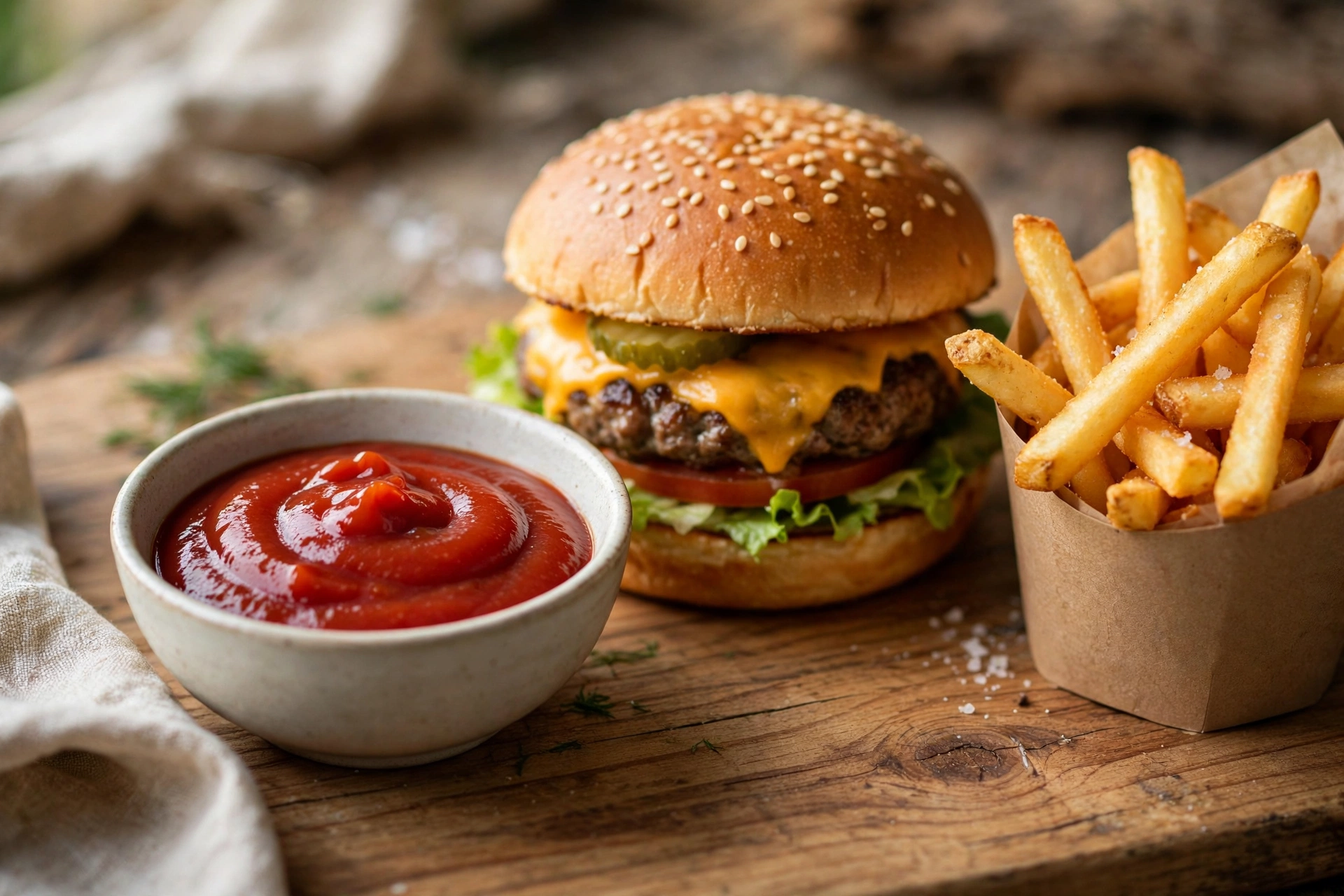
- Fries. Try it with our air fryer sweet potato fries recipe.
- Burgers. A spoonful on our low sodium turkey burger recipe beats bottled ketchup by a wide margin.
- As an ingredient. Use it in our low sodium BBQ sauce recipe — it keeps the BBQ sauce at 9 mg per serving.
- With eggs. A spoonful beside scrambled eggs.
- As a dip. Serve it with chicken tenders, onion rings, or roasted vegetables.
For more low-sodium sauces, see our low sodium marinara sauce recipe and our low sodium mustard recipe .
Nutrition per Serving
Each serving of this low sodium ketchup recipe is 1 tablespoon. The numbers come from USDA values for every ingredient, batch totals divided by 16 servings.
| Nutrient | Per serving |
|---|---|
| Calories | 26 |
| Protein | 1 g |
| Carbohydrates | 6 g |
| Fiber | 1 g |
| Sugar | 5 g |
| Fat | 0 g |
| Saturated fat | 0 g |
| Sodium | 2 mg |
| Cholesterol | 0 mg |
At 2 mg of sodium, this ketchup meets the FDA’s “sodium free” definition of under 5 mg per serving. Harvard’s guide to salt and sodium explains why condiments matter: small servings that add up fast across a meal, and most dietary sodium comes from processed foods and sauces, not the salt shaker.
FAQs
How much sodium is in homemade ketchup?
This low sodium ketchup recipe has 2 mg of sodium per tablespoon, because it uses no-salt-added tomato paste with no added salt. Heinz has about 160 mg per tablespoon and Hunt’s about 180 mg — salt manufacturers add as a preservative and flavor enhancer.
Can I make ketchup without salt?
Yes — this low sodium ketchup recipe uses no salt at all, and the flavor comes from tomato paste, vinegar, honey, and six spices — including cinnamon and cloves, the warm background spices in classic ketchup. Salt is a preservative in bottled ketchup, not a flavor you need in a fresh sauce.
How long does homemade ketchup last?
Fridge: up to 2 weeks in a clean jar or squeeze bottle with a tight lid. Freezer: up to 3 months. Homemade ketchup lasts less time than bottled ketchup — it has no salt as a preservative. If it smells off or looks moldy, throw it away.
Is ketchup good for weight loss?
This low sodium ketchup recipe has 26 calories and 5 grams of sugar per tablespoon — similar to Heinz on sugar, far lower on sodium. It is a reasonable condiment in small amounts. The key is portion size: measure 1–2 tablespoons instead of squeezing freely.
Why does my homemade ketchup taste too sweet?
The honey and brown sugar may be too much for your taste. Stir in an extra teaspoon of white vinegar to balance the sweetness. Next time, cut the honey to 1 tablespoon. The flavor deepens as it cools, so taste it at room temperature before you judge.
Can I use tomato sauce instead of tomato paste?
Tomato paste works better because it is thick and concentrated. Tomato sauce is thinner, so this low sodium ketchup recipe would need a longer simmer — about 30 minutes instead of 15 — and the flavor would be milder. If you use tomato sauce, use no-salt-added and reduce the water.
The Bottom Line
This low sodium ketchup recipe gives you about a cup of real ketchup at 2 mg of sodium per tablespoon, in 20 minutes, with ingredients you already have. Make it fresh, keep it in the fridge, and use it all week.
This article is for general information only and is not medical advice. Please talk to your doctor or a registered dietitian, especially if you have diabetes, heart disease or take medicine.