Best Oils for Heart Health: 7 Cooking Oils Ranked
The best oils for heart health are cooking oils rich in unsaturated fats. The seven are extra virgin olive oil, avocado oil, canola oil, high-oleic sunflower oil, flaxseed oil, walnut oil and sesame oil. This guide covers cooking oils only (essential oils are a different topic). Olive oil leads. It is the most studied oil for heart health, with the best evidence for lowering heart disease risk.

Key Takeaways
- The best oils for heart health are rich in monounsaturated and polyunsaturated fats and low in saturated fat.
- Extra virgin olive oil is the top pick — the most researched oil, with the best evidence.
- Avocado oil (520°F) is the best choice for high-heat cooking; flaxseed and walnut oils are for cold use only.
- Coconut oil is 82% saturated fat — the American Heart Association advises limiting it.
- All oils have about 120 calories per tablespoon, so measure rather than pouring freehand.
In This Post
- Why Does the Type of Fat Matter?
- The 7 Best Oils at a Glance
- 1. Extra Virgin Olive Oil
- 2. Avocado Oil
- 3. Canola Oil
- 4. High-Oleic Sunflower Oil
- 5. Flaxseed Oil (Cold Use Only)
- 6. Walnut Oil (Cold Use Only)
- 7. Sesame Oil
- Oils to Limit: Coconut, Palm and Butter
- Are Seed Oils Bad for Your Heart?
- Which Oil for Which Job?
- How to Store Cooking Oils
- FAQs
Why Does the Type of Fat Matter?
When it comes to heart health, the type of fat matters more than the amount. Unsaturated fats may help lower LDL (“bad”) cholesterol when they replace saturated fat. The two kinds are monounsaturated (MUFA) and polyunsaturated (PUFA). Saturated fat raises LDL cholesterol, which is why the American Heart Association recommends limiting it. For more on cholesterol and food, see our guide on are eggs bad for cholesterol.
All cooking oils are pure fat, with about 120 calories per tablespoon. So the difference between oils is not the calories, but the fat profile. The best oils for heart health are the ones with the most unsaturated fat and the least saturated fat. Olive oil, for example, is 73% monounsaturated fat and only 14% saturated; coconut oil is 82% saturated fat.
The 7 Best Oils for Heart Health at a Glance
The best oils for heart health, ranked by fat profile and evidence. The table shows fat breakdown per 100 g and smoke points.
| Oil | MUFA | PUFA | Saturated | Smoke point | Best use |
|---|---|---|---|---|---|
| 1. Extra virgin olive oil | 73 g | 11 g | 14 g | ~375–405°F | Dressings, sauté, roasting |
| 2. Avocado oil | 70 g | 14 g | 12 g | ~520°F | High-heat cooking, roasting |
| 3. Canola oil | 64 g | 28 g | 7 g | ~400°F | Everyday cooking, baking |
| 4. High-oleic sunflower oil | ~82 g | 9 g | 9 g | ~450°F | Frying, roasting |
| 5. Flaxseed oil | 18 g | 68 g | 9 g | ~225°F | Cold only — dressings, smoothies |
| 6. Walnut oil | 23 g | 63 g | 9 g | ~320°F | Cold only — dressings |
| 7. Sesame oil | 40 g | 42 g | 14 g | ~410°F | Stir-fries, finishing |
Olive oil tops the list. It has the strongest research behind it, not just the best fat numbers.
1. Extra Virgin Olive Oil
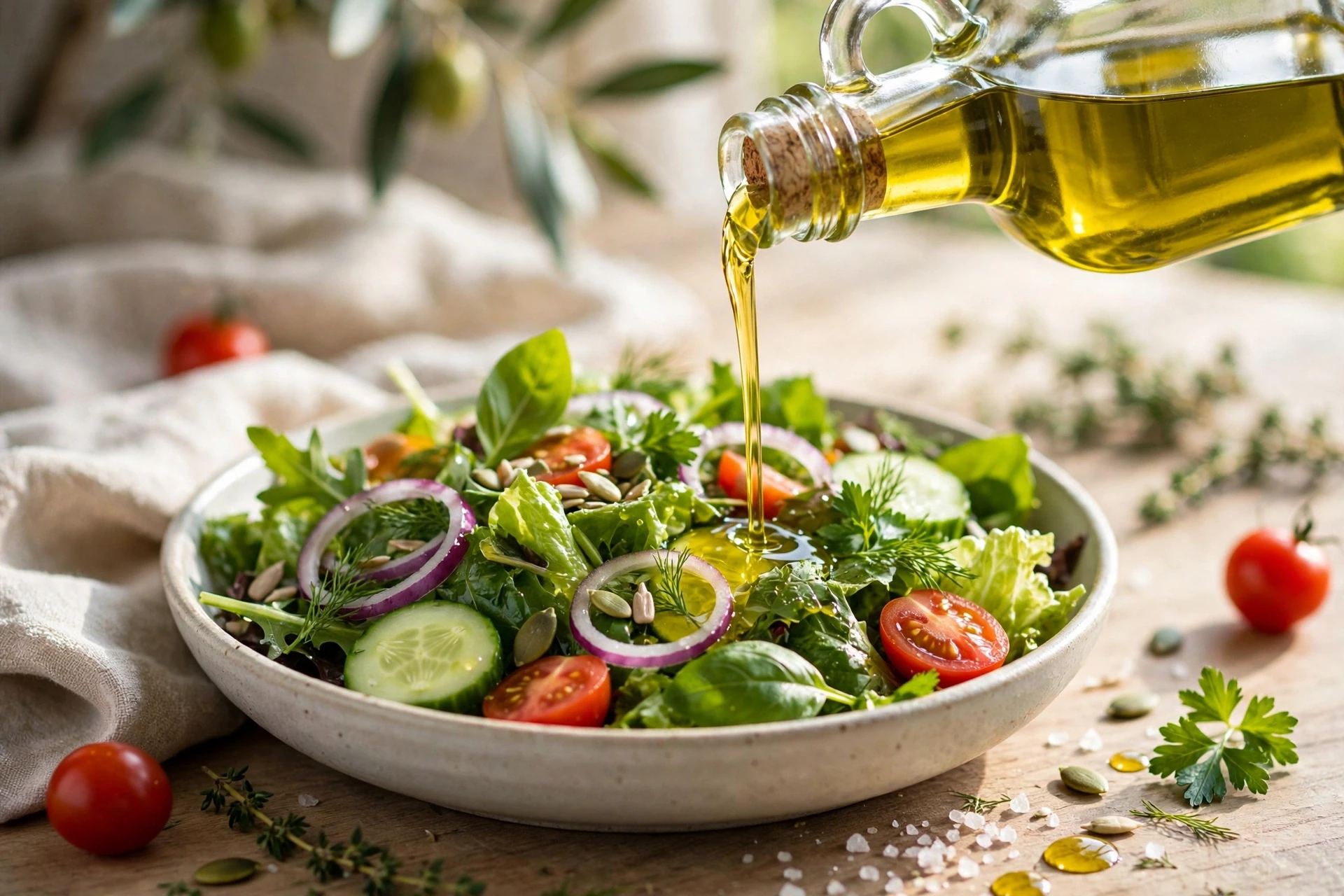
Of the best oils for heart health, extra virgin olive oil is the top pick. It is the most researched cooking oil, with the best evidence for lowering heart disease risk. A 2026 Heart Foundation position statement called olive oil the most-studied oil. It has the best heart outcomes of any cooking fat. It is 73% MUFA and low in saturated fat at 14%. It is also rich in polyphenols — plant compounds that act as antioxidants.
Use it for dressings, sautéing and roasting. Its smoke point (375 to 405°F) is high enough for most everyday cooking. The idea that you cannot cook with olive oil is a myth. Buy extra virgin (cold-pressed, unrefined) rather than “light” or “pure” olive oil, which are more processed. Our low sodium salad dressing recipes use olive oil as the base.
2. Avocado Oil
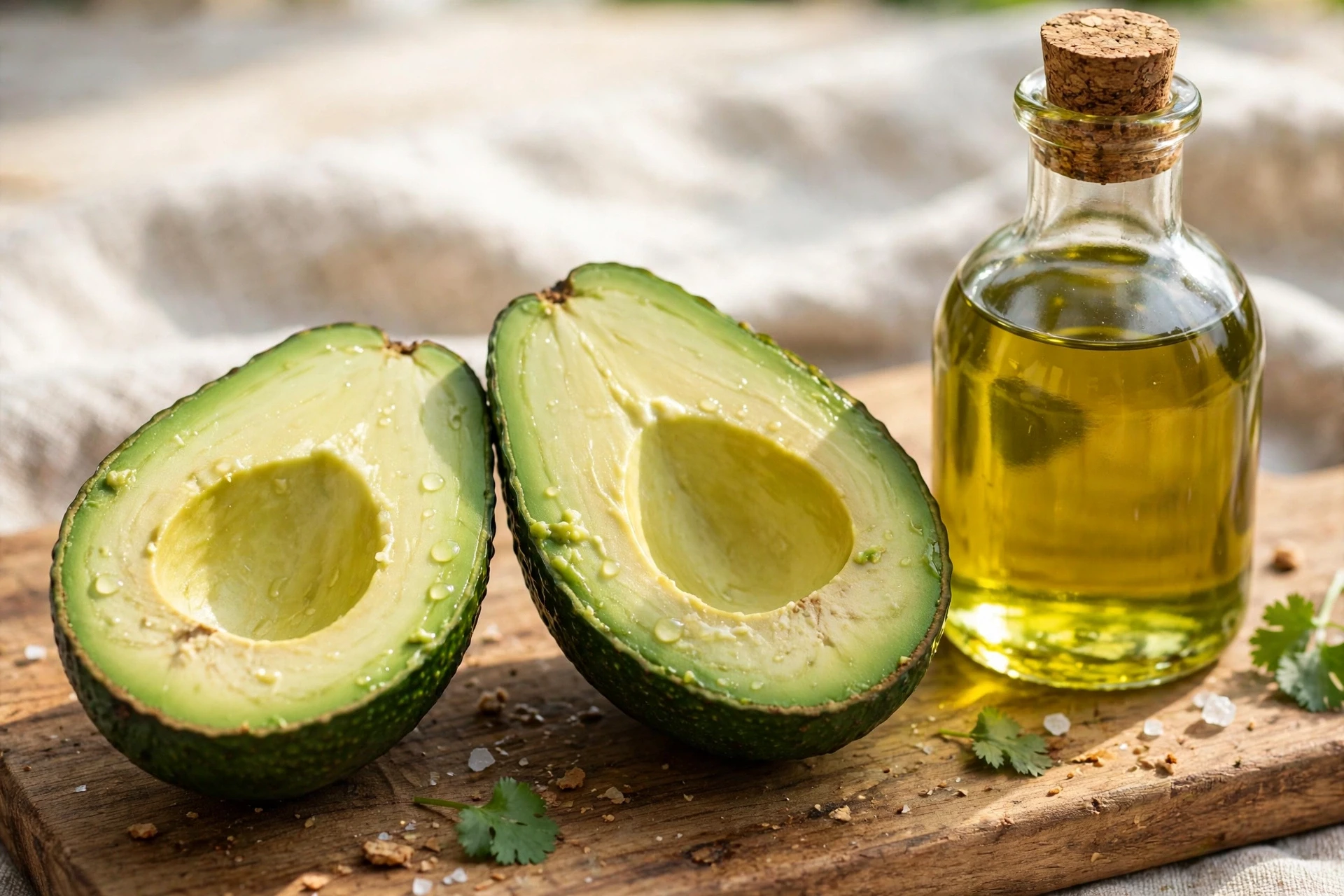
Of the best oils for heart health, avocado oil is the pick when you need high heat. Its smoke point is about 520°F — the highest on this list — which makes it the safest choice for searing, roasting and frying. Its fat profile is close to olive oil: 70% MUFA, 14% PUFA, and only 12% saturated.
It has a mild, buttery flavour that works in almost any dish. It is also a good neutral oil for baking. The downside is price — avocado oil usually costs more than olive oil. If you cook at high heat often, keep a bottle for those jobs and use olive oil for the rest.
3. Canola Oil
Of the best oils for heart health, canola oil has the lowest saturated fat — just 7 g per 100 g, the lowest of any common cooking oil. It is 64% MUFA and 28% PUFA, and a network meta-analysis cited by the Heart Foundation found canola oil the most beneficial for blood lipids.
Canola oil is also the most affordable oil on this list and has a neutral flavour. That makes it the best everyday cooking oil for baking, sautéing and roasting. Its smoke point is about 400°F. Look for “expeller-pressed” canola oil if you prefer less processing.
4. High-Oleic Sunflower Oil
High-oleic sunflower oil is the highest in MUFA on this list — about 82%. Its smoke point is about 450°F, which makes it a good all-rounder for frying and roasting. It is also one of the cheapest heart-healthy oils.
The “high-oleic” part matters. Regular sunflower oil is high in PUFA and lower in MUFA, which makes it less stable at high heat. Check the label: if it does not say “high-oleic,” it is the regular kind. High-oleic sunflower oil is widely available.
5. Flaxseed Oil (Cold Use Only)
Of the best oils for heart health, flaxseed oil has the most plant omega-3 — about 53 g of ALA per 100 g, more than any other oil. Its total PUFA is 68%, with only 9% saturated fat.
But flaxseed oil is strictly for cold use. Its smoke point is about 225°F. Heat destroys the ALA and can make the oil taste bitter. Use it in salad dressings, drizzled over cooked vegetables, or in smoothies. Keep it in the fridge — it goes rancid faster than any other oil here.
6. Walnut Oil (Cold Use Only)
Among the best oils for heart health, walnut oil has the richest flavour and a strong fat profile — 63% PUFA (including about 10 g of ALA per 100 g) and only 9% saturated fat. It shines in dressings and finishing dishes.
Like flaxseed oil, walnut oil is for cold use. Its smoke point is about 320°F. Heating it destroys the flavour and the omega-3 fats. Buy small bottles and keep it in the fridge. It goes rancid within a few months of opening.
7. Sesame Oil
Sesame oil is the most flavourful oil on this list — a little goes a long way. It is 40% MUFA and 42% PUFA, with 14% saturated fat. Toasted sesame oil (dark, fragrant) is for finishing dishes. Light sesame oil (pale, mild) is for cooking, with a smoke point of about 410°F.
Use toasted sesame oil by the teaspoon, not the tablespoon — a drizzle over a stir-fry, noodle bowl or salad adds a deep, nutty flavour. It adds healthy fats to Asian-style cooking.
Oils to Limit: Coconut, Palm and Butter
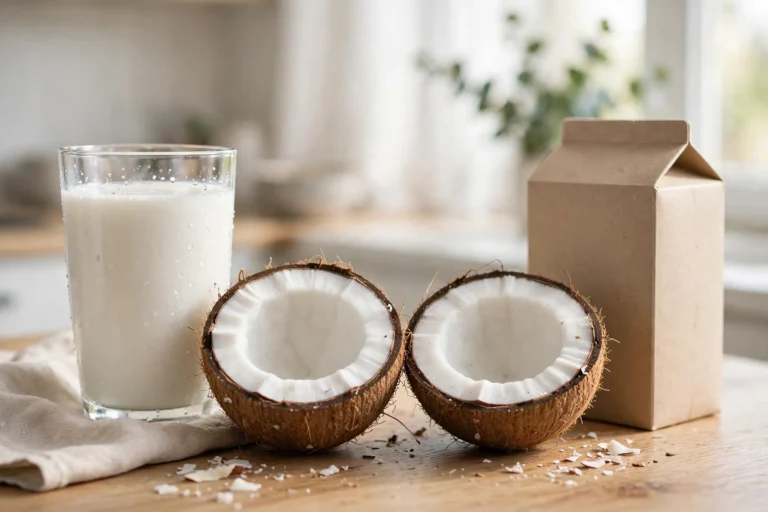
Not all cooking fats are heart-healthy. Coconut oil is 82% saturated fat — higher than butter (about 51%). The American Heart Association advises limiting it. It raises HDL (“good”) cholesterol, but it raises LDL (“bad”) cholesterol too. That is why the AHA says to use it sparingly, if at all.
Palm oil is more than 50% saturated fat and is best avoided. It appears in many processed foods, so check labels. Butter, at about 51% saturated fat, is fine in small amounts. But it should not be your everyday cooking fat. The best oils for heart health are the unsaturated ones above — replacing butter with olive, canola or sunflower oil is one of the simplest swaps for your heart. See our guide to foods to avoid with high cholesterol for the full picture.
Are Seed Oils Bad for Your Heart?
You may have heard that seed oils (canola, sunflower, soybean, corn) are “toxic.” The evidence does not support that claim. The Heart Foundation’s 2026 position statement found no human evidence that seed oils cause harm at typical amounts. Replacing butter or beef fat with sunflower, canola or corn oil improves LDL cholesterol.
Seed oils are high in PUFA, the fat most strongly linked to lower LDL cholesterol. The concern comes mainly from animal studies and from the fact that seed oils are common in processed foods. But the oils themselves, used in normal cooking amounts, are heart-healthy. The best oils for heart health include canola and high-oleic sunflower oil, both seed oils.
Which Oil for Which Job?
The best oils for heart health are not all interchangeable — the right oil depends on the job:
| Job | Best oil | Why |
|---|---|---|
| Salad dressing | Extra virgin olive oil, walnut oil, flaxseed oil | Flavour + no heat needed |
| Sautéing | Extra virgin olive oil, canola oil | Moderate heat, good fat profile |
| Roasting | Avocado oil, olive oil, canola oil | Stable at oven temperatures |
| High-heat frying | Avocado oil, high-oleic sunflower oil | Highest smoke points |
| Baking | Canola oil, light olive oil | Neutral flavour |
| Finishing / drizzle | Toasted sesame oil, walnut oil, EVOO | Flavour is the point |
If you keep just two oils, make them extra virgin olive oil (dressings and everyday cooking) and avocado oil (high heat). That covers almost every job. Our avocado cilantro lime salad dressing shows how a good oil makes a dressing.
How to Store Cooking Oils
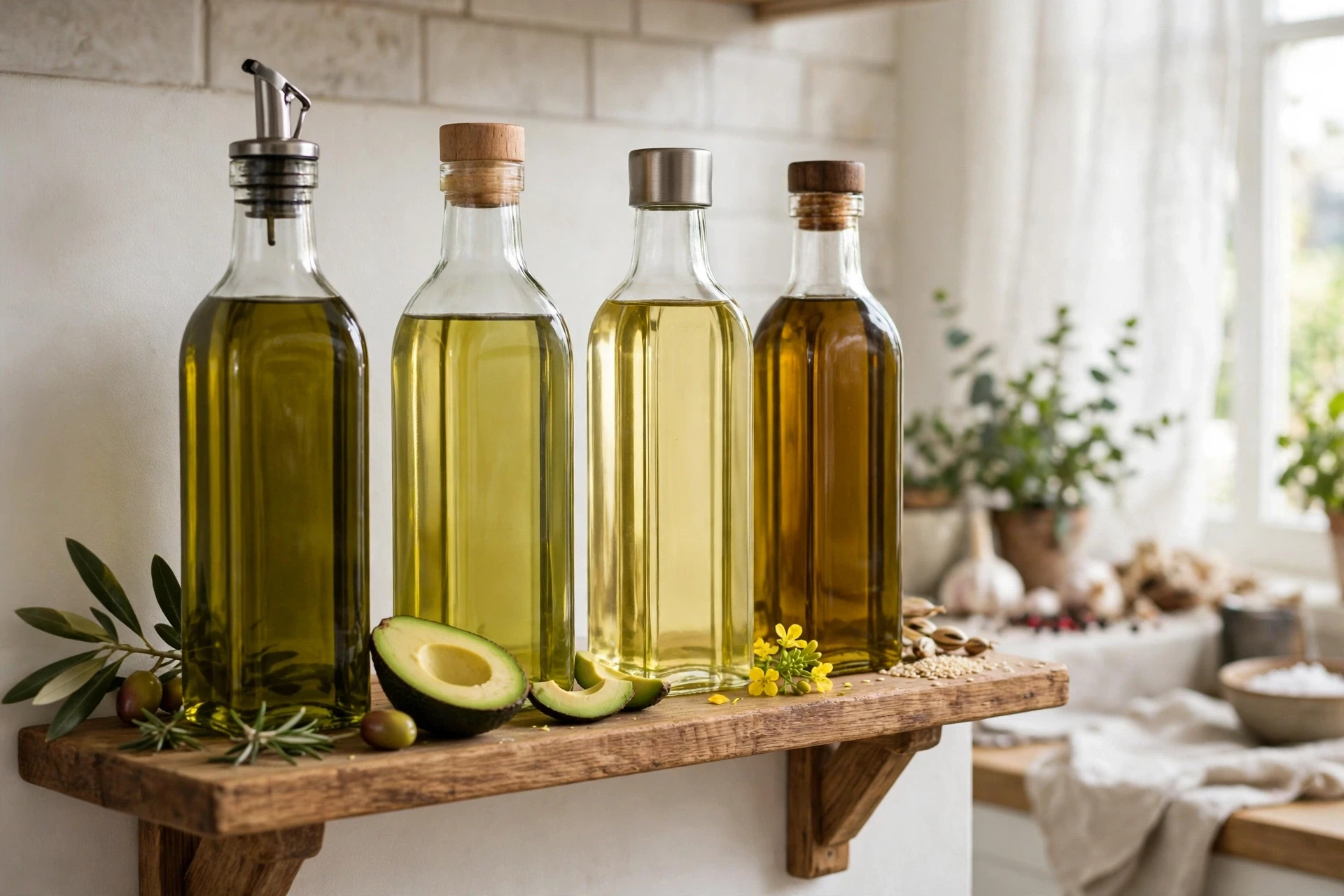
The best oils for heart health go rancid if you store them badly — rancid oil tastes bitter and loses its healthy compounds. Light, heat and oxygen are the enemies. Store oils in a cool, dark cupboard (not next to the stove), in their dark bottles, with the cap on tight.
Buy small bottles and use them within a few months. Extra virgin olive oil keeps about 6 months after opening; flaxseed and walnut oils keep only a few weeks in the fridge. If an oil smells like crayons or old paint, it has gone rancid.
FAQs
Which oil is best for heart patients?
Of the best oils for heart health, extra virgin olive oil is the top pick for heart patients — the most researched cooking oil, with the best evidence for lowering heart disease risk. It is 73% MUFA and rich in polyphenols. Avocado oil and canola oil are also excellent choices.
Is canola oil healthy?
Yes — canola oil is one of the healthiest cooking oils. It has the lowest saturated fat of any common oil (7 g per 100 g) and a network meta-analysis found it the most beneficial for blood lipids. It is affordable, neutral-tasting and good for baking, sautéing and roasting.
What is the healthiest oil for frying?
Avocado oil is the healthiest oil for frying, with a smoke point of about 520°F — the highest on this list. High-oleic sunflower oil (about 450°F) is a good cheaper alternative. Avoid frying with flaxseed or walnut oil, which break down at low temperatures.
Is coconut oil bad for your heart?
Coconut oil is 82% saturated fat — higher than butter — and the American Heart Association advises limiting it. It raises HDL (“good”) cholesterol, but it also raises LDL (“bad”) cholesterol. Use it sparingly if you enjoy the flavour. Olive, avocado and canola oils are better daily choices.
Is olive oil good for cholesterol?
Yes — olive oil may help lower LDL (“bad”) cholesterol when it replaces saturated fat. It is 73% MUFA and rich in polyphenols. The Heart Foundation’s 2026 position statement called olive oil the most-studied oil with the best heart outcomes. Use extra virgin olive oil for the most benefit.
What oil has the lowest saturated fat?
Canola oil has the lowest saturated fat of any common cooking oil, at 7 g per 100 g. High-oleic sunflower oil (9 g), flaxseed oil (9 g) and walnut oil (9 g) are close behind. By comparison, olive oil has 14 g, butter about 51 g, and coconut oil 82 g per 100 g.
Start With Olive Oil
If you buy one of the best oils for heart health, make it extra virgin olive oil — the best-researched and most versatile. Add avocado oil for high-heat cooking and flaxseed oil for dressings. Two or three good oils, stored well and used in the right jobs, cover everything. For the bigger picture, see our guide to the best foods for heart health. The American Heart Association’s diet and lifestyle recommendations give the full guidance on fats.
This article is for general information only and is not medical advice. Please talk to your doctor or a registered dietitian, especially if you have diabetes, heart disease or take medicine.