Is Coconut Oil Bad for Cholesterol? What Studies Say
Is coconut oil bad for cholesterol? Yes, in large amounts — one tablespoon has about 12 grams of saturated fat, nearly the whole AHA daily budget. It raises LDL more than olive oil but less than butter, and it raises HDL too. How much you use matters most.
By Sarah | Last updated: November 11, 2026

Key Takeaways
- Is coconut oil bad for cholesterol? Yes, in large amounts — it is 82–86% saturated fat, more than butter (52%) by share.
- Studies show coconut oil raises LDL by about 10 mg/dL vs non-tropical vegetable oils.
- Coconut oil also raises HDL (“good”) cholesterol by about 4 mg/dL — but that does not cancel the LDL rise.
- One tablespoon nearly fills the AHA daily saturated fat budget (about 13 g), so measure it.
- Use coconut oil where its flavour matters; use olive oil for everyday cooking.
In This Article
- Is Coconut Oil Bad for Cholesterol? The Short Answer
- Coconut Oil Nutrition: What’s in a Tablespoon
- What the Studies Found
- The HDL Side of the Story
- Does Coconut Oil Help You Lose Weight?
- How Much Coconut Oil Can You Use?
- Better Oils for Cholesterol
- Who Should Be Careful?
- Frequently Asked Questions
Is Coconut Oil Bad for Cholesterol? The Short Answer
Is coconut oil bad for cholesterol? Yes, when you use it freely. One tablespoon has about 12 grams of saturated fat, nearly the AHA daily budget of about 13 grams. Compared with olive oil, it raises LDL. Compared with butter, it raises LDL less. A measured spoonful in curry is a different food from a panful used for daily frying.
The question gets confusing because coconut oil has two faces. It is one of the most saturated fats in the kitchen — 82 to 86 percent of its fat is saturated, a higher share than butter’s 52 percent. At the same time, it raises HDL cholesterol, the kind you want higher. The studies below show why the LDL side wins.
Coconut Oil Nutrition: What's in a Tablespoon
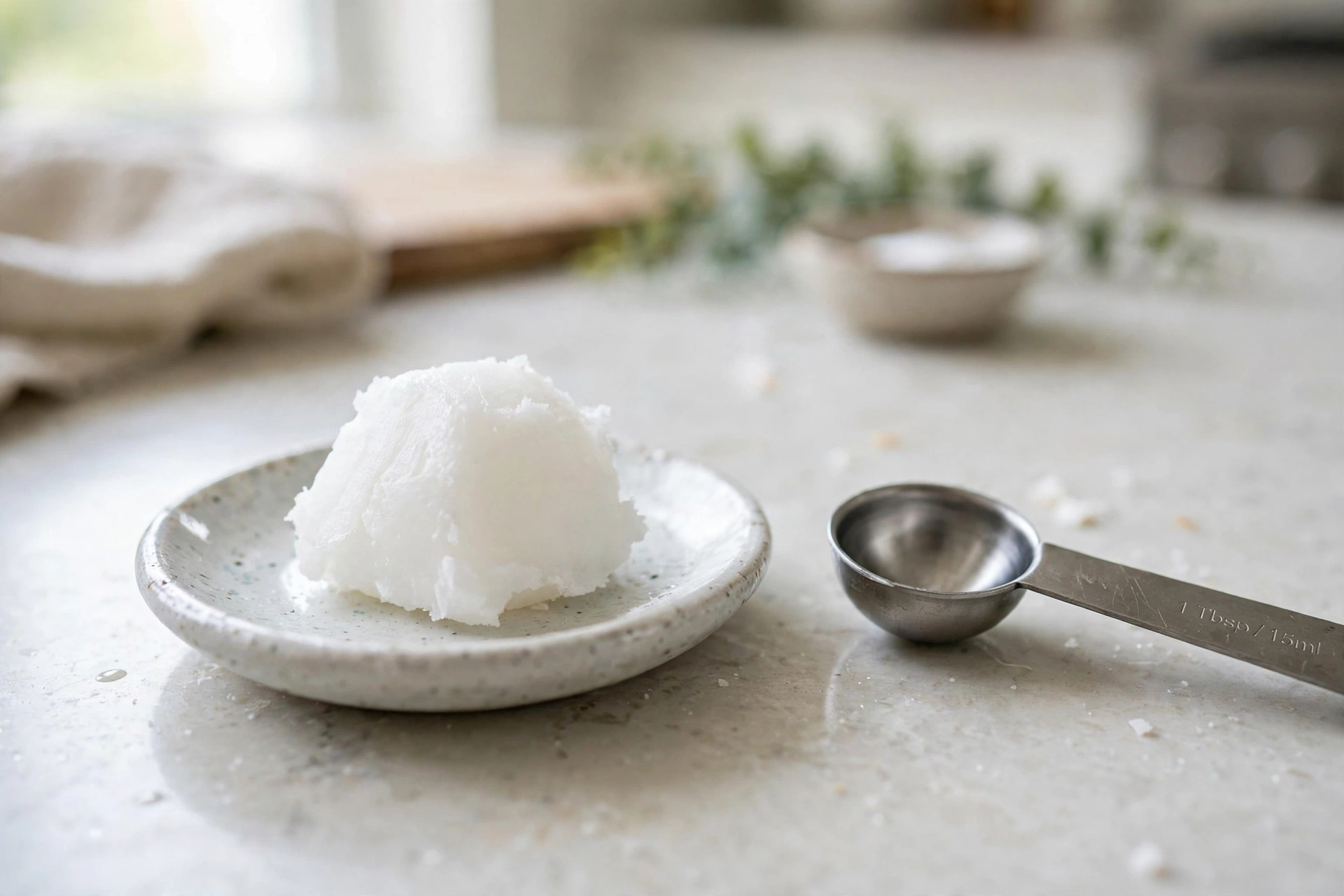
A tablespoon of coconut oil has about 120 calories and 14 grams of fat, about 12 of them saturated. It has no cholesterol — no plant food does — but dietary cholesterol is not the main driver of blood cholesterol. Saturated fat is.
| Oil / fat (1 tbsp) | Saturated fat | Main fat type |
|---|---|---|
| Coconut oil | ~12 g | Lauric acid (saturated) |
| Butter | ~7 g | Palmitic acid (saturated) |
| Olive oil | ~2 g | Oleic acid (monounsaturated) |
| Canola oil | ~1 g | Oleic acid (monounsaturated) |
The table makes the budget test simple — and it is the clearest answer to “is coconut oil bad for cholesterol?”. One tablespoon of coconut oil is nearly six times the saturated fat of olive oil. It spends almost the whole AHA daily budget in a single spoonful. For the full comparison, see our guide to butter and cholesterol .
The lauric acid myth
About half the fat in coconut oil is lauric acid. It is often sold as a medium-chain triglyceride (MCT) — the kind of fat your body burns quickly. That claim does not hold up, and it is the key to the coconut oil myth.
Lauric acid behaves like a long-chain saturated fat in the body, not like the shorter MCTs in MCT oil. It raises LDL the way other saturated fats do. So when you ask “is coconut oil bad for cholesterol?”, the lauric acid does not rescue it.
What the Studies Found
The trial evidence on “is coconut oil bad for cholesterol?” is unusually honest — two good meta-analyses reached different answers. The largest, published in Circulation in 2020, pooled 16 trials. It found coconut oil raised LDL by 10.47 mg/dL and HDL by 4.00 mg/dL vs non-tropical vegetable oils. That is a real LDL rise.
A second meta-analysis of 7 trials with 515 people found no significant LDL change. HDL still rose, by 3.28 mg/dL. Why the difference? The trials used different comparison oils, doses, and lengths. Against butter, coconut oil looks good. Against olive oil, it looks worse. A review of 21 studies summed it up: coconut oil raised total and LDL cholesterol more than unsaturated plant oils, but less than butter.
The cleanest head-to-head trial compared coconut oil directly with olive oil. LDL came out about the same, while coconut oil raised HDL more. In a network meta-analysis of 54 trials, coconut oil ranked first for raising HDL. But every oil there gave lower LDL than butter. The pattern is consistent: coconut oil sits between butter and unsaturated oils — closer to butter on LDL.

The HDL Side of the Story
Coconut oil’s best defence is real: it raises HDL cholesterol, the kind that carries cholesterol away from your arteries. The Circulation meta-analysis put the rise at 4.00 mg/dL. The network meta-analysis ranked coconut oil first for raising HDL. That sounds like a win — but it does not cancel the LDL rise.
Here is why. LDL cholesterol is the main driver of artery plaque. Raising HDL does not undo the harm of raising LDL. Drug trials that raised HDL without lowering LDL did not reduce heart disease. So when you ask “is coconut oil bad for cholesterol?”, the HDL rise is a genuine plus — but not a free pass. Olive oil raises HDL too, without the LDL cost. If your HDL is low, the fix is exercise and unsaturated fats.
Does Coconut Oil Help You Lose Weight?
No — and this is the second myth worth clearing up. Coconut oil is sometimes sold as a weight-loss food because of the MCT claim. But a 2025 analysis of 15 trials with more than 600 people found no effect on body weight, BMI, or waist size.
Doses ranged from 10 to 50 grams a day. At 120 calories a tablespoon, coconut oil adds energy fast without burning it off.
That matters for the “is coconut oil bad for cholesterol?” question too. Extra weight raises LDL and triglycerides on its own. If you add coconut oil to coffee or smoothies for weight loss, the evidence says you are adding calories without the payoff. Save it for cooking where you can taste it.
How Much Coconut Oil Can You Use?
The practical answer to “is coconut oil bad for cholesterol?” is a measuring spoon. The AHA advises keeping saturated fat below 6 percent of calories — about 13 grams a day on a 2,000-calorie diet. One tablespoon of coconut oil is about 12 grams. That uses nearly the whole day’s budget, leaving almost nothing for cheese or meat.
I use coconut oil in curry — the flavour is the point there — but I measure it now, one tablespoon, and I let the vegetables and lentils do the rest. For everyday frying, sautéing, and roasting, olive oil is the better default. It has about 2 grams of saturated fat per tablespoon. The same spoonful costs one-sixth of the budget.
The WHO’s 2023 guidance allows saturated fat up to 10 percent of calories — about 22 grams a day, more generous than the AHA. Even on that looser budget, two tablespoons of coconut oil would spend the whole day. The rule is the same: measure it, use it where the flavour earns its place, and don’t fry in it daily.

Better Oils for Cholesterol
If you cook with oil, the swap matters more than any single ingredient. Olive oil is the best-studied choice — see our guide to olive oil for cholesterol . It lowers LDL, raises HDL, and protects LDL from oxidation. Canola oil is close behind, with about 1 gram of saturated fat per tablespoon.
| Swap | Saturated fat per tbsp | Best for |
|---|---|---|
| Olive oil (extra virgin) | ~2 g | Sautéing, roasting, dressings |
| Canola oil | ~1 g | Everyday frying, baking |
| Avocado oil | ~1.6 g | High-heat cooking |
| Coconut oil | ~12 g | Curry flavour (measured) |
I switched my everyday frying to olive oil after asking myself “is coconut oil bad for cholesterol?” — and kept coconut oil for the dishes where I can actually taste it. That one change cut the saturated fat in my cooking by about five-sixths. Our olive-oil dressing uses the same swap for salads. A strong soluble fiber foods habit helps too — fibre pulls LDL down while the oil swap stops pushing it up.
Who Should Be Careful?
Most people can use a measured tablespoon of coconut oil sometimes without harm. But some groups should be stricter. If your LDL is above 130 mg/dL, if you have heart disease or diabetes, or if close family had heart disease early, coconut oil is a poor daily choice. The LDL rise is the last thing you need.
If you take a statin, coconut oil does not cancel the medicine, but it works against it — adding saturated fat while the statin lowers LDL. If you follow a keto or high-fat diet that leans on coconut oil, check your LDL with your doctor. Several studies show LDL climbing on coconut-heavy diets even when weight falls. Our guide to foods to avoid with high cholesterol lists the other foods to limit.
Frequently Asked Questions
Is coconut oil bad for cholesterol if I only use a little?
A little is fine for most people. One teaspoon has about 4 grams of saturated fat — roughly a third of the AHA daily budget — so a teaspoon in a curry is a reasonable treat. The problem is the tablespoon habit: one tablespoon nearly fills the day’s budget, so measure it.
Is coconut oil worse than butter for cholesterol?
No — coconut oil raises LDL less than butter in head-to-head comparisons, even though it is more saturated by share (86% vs 52%). Butter adds dietary cholesterol too. Both raise LDL, though, so neither is a good daily cooking fat if your LDL is high.
Is coconut oil bad for cholesterol if it raises HDL?
Yes. The Circulation 2020 meta-analysis found coconut oil raised HDL by 4.00 mg/dL vs non-tropical vegetable oils, and a network meta-analysis ranked it first for raising HDL. But the HDL rise does not cancel the LDL rise, so it is not a reason to use coconut oil freely.
Is coconut oil good for your heart?
Not as a daily cooking fat. The AHA advises against excessive coconut oil use because of its saturated fat, and the WHO caps saturated fat at 10 percent of calories. Coconut oil’s HDL rise and flavour are real pluses, but olive oil gives the heart benefits without the LDL cost.
Is coconut oil bad for cholesterol if I cook with it every day?
You can, but it is hard to stay inside the saturated fat budget. One tablespoon a day nearly fills the AHA budget, leaving no room for cheese or meat. If you cook daily, use olive oil or canola oil as the default and save coconut oil for the dishes where its flavour matters.
Is refined or unrefined coconut oil better for cholesterol?
Neither is better for cholesterol — both are about 82–86% saturated fat, and refining does not change the fat profile. Unrefined (virgin) coconut oil keeps more flavour, which is a cooking choice, not a health one. For cholesterol, the amount you use matters far more than the type.
Your Next Step
So, is coconut oil bad for cholesterol? In large amounts, yes — one tablespoon nearly fills the AHA daily saturated fat budget and raises LDL by about 10 mg/dL. In small, measured amounts where its flavour earns its place, it can fit. Measure your next spoonful, or switch everyday frying to olive oil. Your LDL will notice the difference.
This article is for general information only and is not medical advice. Please talk to your doctor or a registered dietitian, especially if you have diabetes, heart disease or take medicine.
Sources: British Heart Foundation — coconut oil (86% saturated fat); Circulation 2020 meta-analysis (16 trials, LDL +10.47 mg/dL, HDL +4.00 mg/dL); 7-RCT meta-analysis (515 people, HDL +3.28 mg/dL); Schwingshackl 2018 network meta-analysis (54 trials); 2025 weight analysis (15 trials, 600+ people); American Heart Association — saturated fat guidance (<6% of calories); WHO 2023 saturated fat guidance (<10% of calories). Outbound link: British Heart Foundation — Is coconut oil good for you?