Low Sodium Teriyaki Sauce Recipe (10 Minutes)
By Sarah
This low sodium teriyaki sauce recipe gives you the sweet, salty gloss you love, with far less salt than the bottle.
Direct answer: This low sodium teriyaki sauce recipe has 108 mg of sodium per 1/4 cup (27 mg per tablespoon). It is ready in 10 minutes. It uses coconut aminos instead of soy sauce, plus pineapple juice, maple syrup, garlic, and ginger. It works as a glaze, a marinade, or a stir-fry sauce.
Key Takeaways
- One 1/4-cup serving of this low sodium teriyaki sauce recipe has 108 mg of sodium — 27 mg per tablespoon.
- Ready in 10 minutes, on the stove or in the microwave.
- Coconut aminos replace soy sauce, so the salt stays low.
In This Post
- Why so much sodium?
- Sodium numbers
- Ingredients
- How to make it
- Which sweetener?
- How to use it
- Storage
- Mistakes to avoid
- FAQ

Why Is Teriyaki Sauce So High in Sodium?
Direct answer: Teriyaki sauce is high in sodium because soy sauce is its main ingredient. One tablespoon of regular soy sauce has more than 1,000 mg of sodium. Bottled teriyaki sauce is mostly soy sauce, sugar, and water, so a few spoonfuls can hold more salt than you expect.
Soy sauce is the problem: one tablespoon of regular soy sauce holds more than 1,000 mg of sodium — almost half of the 2,300 mg daily limit.
“Reduced sodium” only means 25% less than the regular version, and reduced-sodium soy sauce still has about 500 mg per tablespoon. The FDA says “low sodium” means 140 mg or less per serving — see the FDA’s guidance on sodium in your diet.
Even bottled teriyaki is salty: Kikkoman Less Sodium lists 310 mg per tablespoon — so this low sodium teriyaki sauce recipe skips soy sauce entirely.
How Much Sodium Is in This Low Sodium Teriyaki Sauce?
Direct answer: This low sodium teriyaki sauce recipe has 108 mg of sodium per 1/4 cup, or 27 mg per tablespoon. That beats the best low-sodium recipe we found, which had 127 mg per 1/4 cup. Even a “less sodium” bottled teriyaki sauce lists 310 mg per tablespoon.
| Sauce | Sodium per tablespoon | Sodium per 1/4 cup |
|---|---|---|
| This recipe (Better Heaven Kitchen) | 27 mg | 108 mg |
| The Everyday Kidney Cook | ~32 mg | 127 mg |
| The Mountain Kitchen | 287 mg | ~1,148 mg |
| Slender Kitchen | ~237 mg | ~948 mg |
| Kikkoman Less Sodium Teriyaki Sauce (bottled) | 310 mg | ~1,240 mg |
| Reduced-sodium soy sauce | ~500 mg | ~2,000 mg |
| Regular soy sauce | More than 1,000 mg | More than 4,000 mg |
One serving is 4.7% of the 2,300 mg daily value. The FDA counts a food as low in sodium at 5% or less.
Brands of coconut aminos list 240 to 300 mg per tablespoon, which works out to 96–119 mg per 1/4 cup in this low sodium teriyaki sauce recipe. Either way, it stays under our 120 mg target.
What Ingredients Do You Need for This Low Sodium Teriyaki Sauce Recipe?
Direct answer: You need coconut aminos, unsalted broth, pineapple juice, maple syrup, rice vinegar, garlic, ginger, cornstarch, sesame oil, and water. That is the whole list. There is no soy sauce in this recipe, so the salt stays low while the flavor stays sweet and savory.
- Base: coconut aminos taste like soy sauce, with far less salt. Use unsalted broth.
- Sweet: pineapple juice adds a light tang. Maple syrup adds the classic sweetness.
- Tang: rice vinegar. One tablespoon lifts the sauce.
- Flavor: garlic and ginger. Fresh beats powder; grate the ginger fine.
- Thickener: cornstarch and water. Mixed with cold water first, it turns thin sauce glossy.
- Finish: sesame oil. Stir it in last, off the heat.
Tamari has more sodium. Low-sodium soy sauce works, but at about 500 mg per tablespoon, this low sodium teriyaki sauce recipe would no longer be low in sodium.

How to Make Low Sodium Teriyaki Sauce
Direct answer: Whisk everything but the sesame oil in a small pan. Simmer 2 to 3 minutes, then stir in the cornstarch mix until glossy. Stir in the sesame oil off the heat. This low sodium teriyaki sauce recipe takes 10 minutes, and the microwave method works just as well.
Stovetop Method
- Add everything but the cornstarch mix, water, and sesame oil to a small pan.
- Heat on medium until it simmers gently.
- Mix the cornstarch with the cold water until smooth.
- Pour it in slowly, stirring the whole time.
- Simmer 1 to 2 minutes until glossy.
- Off the heat, stir in the sesame oil.
Microwave Method
- Add everything but the cornstarch mix, water, and sesame oil to a microwave-safe bowl.
- Microwave 1 minute on high. Stir.
- Stir in the cornstarch mix. Microwave 30 seconds more. Stir.
- Repeat in 30-second bursts until it coats a spoon. Stir in the sesame oil last.
The Spoon Test
Dip a spoon in and run a finger across the back. If the line holds, it is done.
I pull the pan off the heat just before the sauce looks thick enough, because it firms up as it cools — if it gets too thick in the jar, I stir in a teaspoon of warm water.


Low Sodium Teriyaki Sauce Recipe (10 Minutes)
Ingredients
Method
- Whisk everything but the cornstarch mix, water, and sesame oil in a small pan.
- Heat on medium until it simmers gently.
- Stir in the cornstarch mix; simmer until glossy.
- Off the heat, stir in the sesame oil. Rest 2 minutes.
- Mix everything except the cornstarch mix, water, and sesame oil in a bowl.
- Microwave 1 minute on high, then stir.
- Stir in the cornstarch mix; microwave in 30-second bursts.
- Stir in the sesame oil last.
Notes
Which Sweetener Should You Use?
Direct answer: Maple syrup gives this sauce its classic sweet taste, with 12 g of sugar per tablespoon. Pineapple juice adds sweetness too, with only about 2 g of sugar per tablespoon. For the lowest sugar, skip the syrup and use extra juice. The table below shows each choice side by side.
| Sweetener | Sugar per tablespoon | Carbs per tablespoon | Notes |
|---|---|---|---|
| Maple syrup | 12 g | 13 g | Classic teriyaki taste |
| Honey | 17 g | 17 g | Sweeter than maple syrup; use less |
| Pineapple juice | About 2 g | About 3 g | Light, fruity sweetness |
| No added sugar | 0 g | 0 g | Use extra pineapple juice for sweetness |
Honey is sweetest but highest in sugar.
For the lowest sugar, skip the syrup and use 4 tablespoons of juice in total. That version has about 2 g of sugar per serving, and the sodium stays at 107 mg.
One serving has 8 g of carbs, about half of one 15 g carb serving, so this low sodium teriyaki sauce recipe can be part of a balanced diet at 1/4 cup or less.
How Do You Use Teriyaki Sauce?
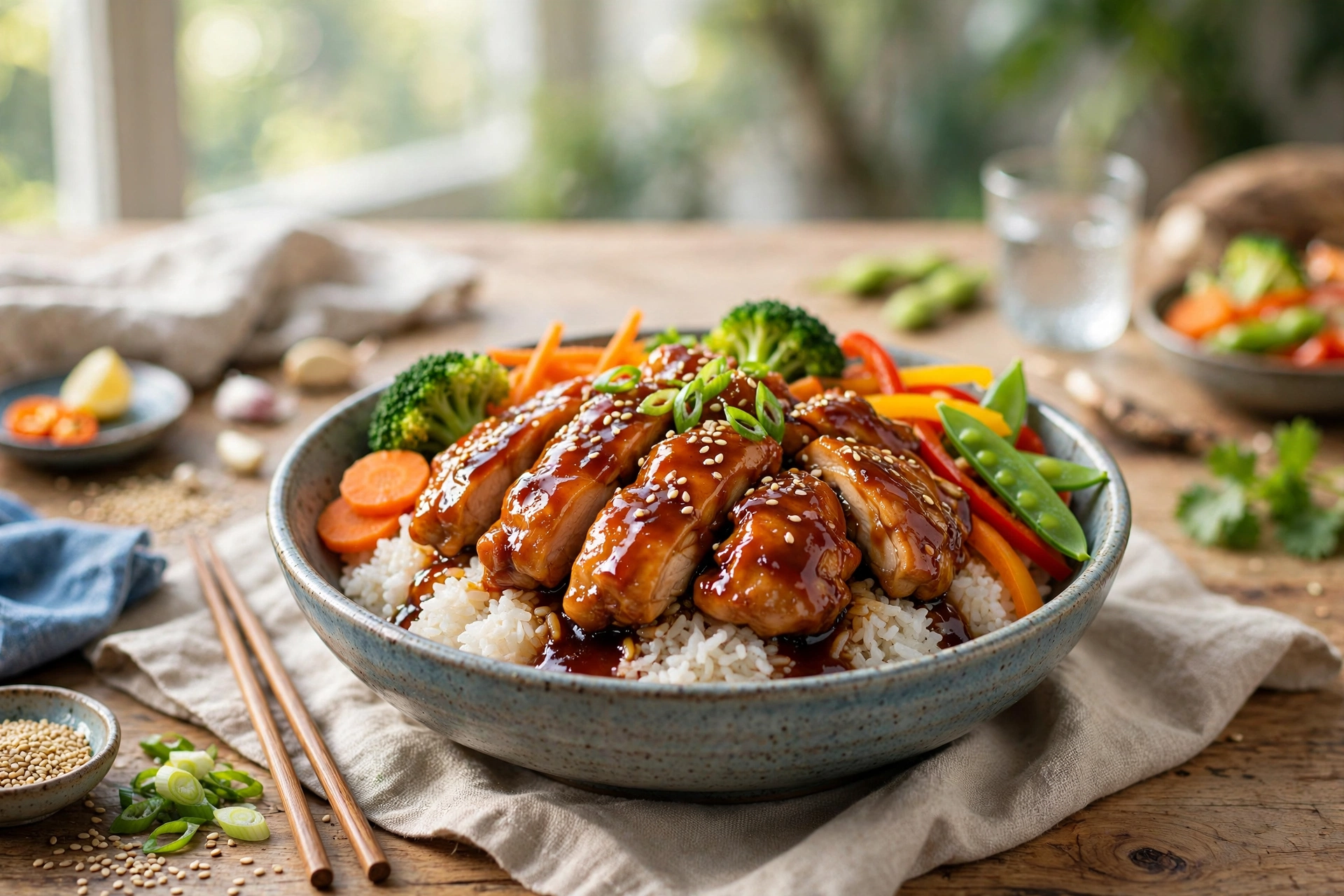
Direct answer: Use it as a glaze, a marinade, a stir-fry sauce, or a dipping sauce. Brush it over chicken or tofu near the end of cooking. Toss it with vegetables and rice for a fast bowl. Set some aside before it touches raw meat if you want sauce for the table.
- Glaze: brush over chicken or tofu near the end.
- Marinade: pour over meat or tofu; chill 30 minutes.
- Stir-fry: toss with vegetables and noodles.
- Bowl: spoon over rice, vegetables, and protein.
- Dip: serve beside dumplings or grilled vegetables.
One batch of this low sodium teriyaki sauce recipe covers about four bowls.
Marinade safety: never reuse marinade that touched raw meat. Set some aside first.
More low-sodium ideas: our low sodium taco seasoning for taco night, our healthy tuna salad with Greek yogurt for lunch, and Low Sodium Stir Fry Sauce Recipe. Serve it with whole wheat bread.
How to Store Low Sodium Teriyaki Sauce
Direct answer: Keep the sauce in a sealed jar in the fridge for up to 1 week. Freeze it in ice cube trays for up to 3 months. Thaw a cube overnight and warm it gently, with a spoon of water if too thick.
Cool it, then refrigerate within 2 hours. It looks thicker when cold — that is normal. Warm it gently.
Freeze the rest in ice cube trays. One cube of this low sodium teriyaki sauce recipe is about 2 tablespoons. Do not refreeze a thawed cube.
Common Mistakes to Avoid
Direct answer: Most teriyaki mistakes come from heat and timing. A sauce that boils too hard can burn, and one that cools too long turns thick. Mix the cornstarch with cold water first and pull the pan off the heat a little early.
- Lumpy: mix cornstarch with cold water first, not hot liquid.
- Burnt: the heat was too high. Maple syrup burns fast.
- Thick: normal — pull the pan off early.
- Weak: sesame oil went in too early. Stir it in off the heat.
- Salty: you used soy sauce — one tablespoon holds over 1,000 mg of sodium.
Frequently Asked Questions
Questions readers ask most about this low sodium teriyaki sauce recipe:
Is teriyaki sauce bad for high blood pressure?
Teriyaki sauce does not cause high blood pressure on its own, but most bottled kinds are very salty. One tablespoon can hold 310 mg of sodium or more. A low-sodium homemade version gives the same flavor with far less salt, and it fits a balanced diet.
How do you thicken teriyaki sauce?
Mix 1 tablespoon of cornstarch with 3 tablespoons of cold water, and stir until smooth. Pour it into the sauce and keep stirring. It will turn glossy and coat a spoon in about 1 minute. If it gets too thick, stir in 1 teaspoon of water.
Can I use teriyaki sauce as a marinade?
Yes. Pour the sauce over chicken, fish, tofu, or vegetables and chill for 30 minutes. Do not pour used marinade over cooked food. Throw away any marinade that touched raw meat. Set some aside before the meat goes in if you want sauce for serving.
How long does homemade teriyaki sauce last?
It keeps for 1 week in the fridge in a sealed jar. For longer storage, freeze it in ice cube trays for up to 3 months. Thaw a cube in the fridge overnight. Throw it out if it smells off or looks moldy.
Is this teriyaki sauce gluten-free?
Yes. Coconut aminos are gluten-free, and so are the rest of the ingredients. If you swap in tamari, check the label — most tamari is gluten-free, but not all brands are. Soy sauce contains wheat, so skip it if you need gluten-free.
Can I make this teriyaki sauce without sugar?
Yes. Skip the maple syrup and use 4 tablespoons of pineapple juice. The sauce tastes sweet, and the sugar drops to about 2 g per serving. Sodium stays at 107 mg per 1/4 cup. It is a good choice if you watch sugar.
Conclusion
This sauce proves low sodium does not mean low flavor. Ten minutes, one pan, and numbers you can trust. Make this low sodium teriyaki sauce recipe tonight and pour it over chicken, tofu, or vegetables.
Next: try the no-added-sugar version, or Low Sodium Stir Fry Sauce Recipe for a second sauce.
This article is for general information only and is not medical advice. Please talk to your doctor or a registered dietitian, especially if you have diabetes, heart disease or take medicine.